
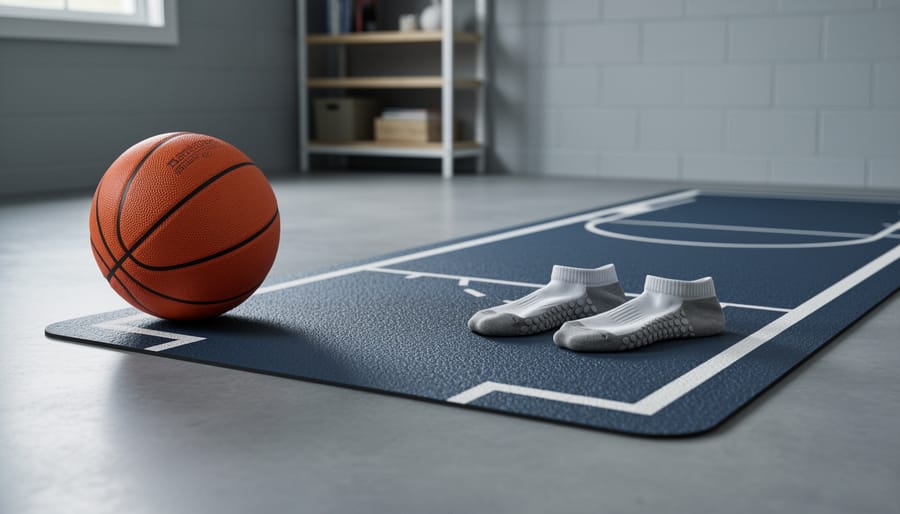
A basketball training mat is a compact, non-slip surface that lets you practise dribbling, footwork, and shooting form at home, often in an apartment or basement where a real court isn’t an option. Most are small enough to unroll in a living room or lay down on a driveway, and the better ones are paired with a quieter ball so you can train without bothering the neighbours.
The market is moving quickly. The SilentBall Academy kit bundles a silent basketball, a training mat, grip socks, and a coach app with more than 100 drills, and its product page lists Canada as an available country with CAD pricing and a 30-day money-back guarantee. Standalone mats vary widely in size. One Amazon.ca listing gives dimensions of 40 x 35 x 3 cm, while a Walmart listing shows a mat of 23.62″ x 15.75″. That’s a big spread, and it matters for how much footwork you can actually fit onto the surface.
One detail remains unconfirmed: safety certifications. Until a manufacturer documents them, treat that as an open question.
This guide breaks down what these mats are, what current listings include, and how to choose one that holds up well beyond the trend, with Canadian buyers and facility operators in mind.
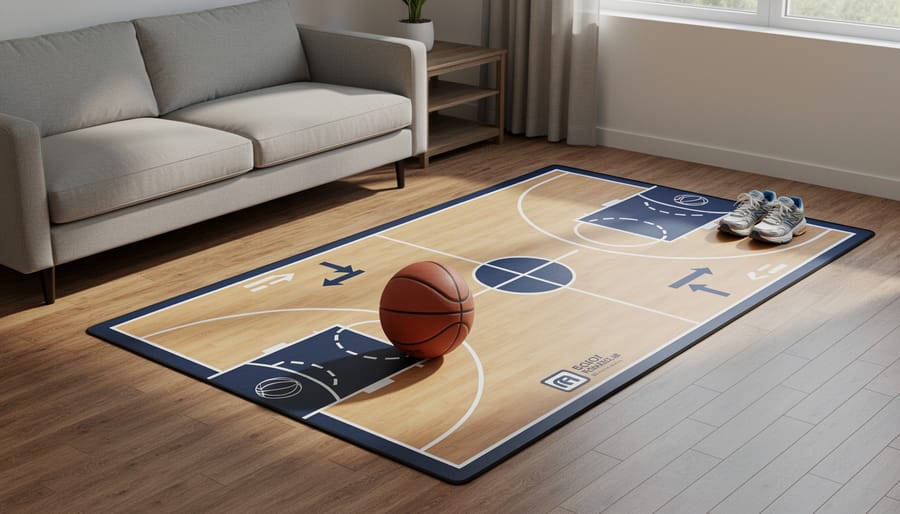
A basketball training mat is a compact, portable surface made for dribbling, ball-handling and footwork drills in places where a full court isn’t an option. Think apartments, basements, garages and driveways. You unroll or lay it down, work on your skills, then put it away.
The appeal is simple. Most players can’t get to a gym every day, but almost anyone can find a few square feet at home. The listings we looked at show how small these tools can be: one Amazon.ca listing gives its product dimensions as 40 x 35 x 3 cm, and a Walmart listing gives a mat size of 23.62″ x 15.75″. That’s closer to a doormat than a court. The current kit-style products also bundle extras, such as a silent basketball, grip socks and a coaching app with more than 100 drills, so you can practise without disturbing the neighbours.
What a mat is not matters just as much. It doesn’t replace a regulation court, and it can’t match a sprung facility floor, which is engineered to absorb impact and give consistent ball response. Official basketball court standards cover dimensions, hoop height and surface requirements that no small mat is designed to meet, and the ASTM indoor sports floor criteria show how demanding performance flooring can be.
So treat a mat as a skill-building tool for tight spaces, not as a stand-in for the real thing.
Here’s a snapshot of what several current listings say. It’s a record of what each page states, not a ranking or recommendation, and it only goes as far as those pages do. If you’re also sorting out the rest of your gear, our basketball equipment checklist covers what players and facilities typically need beyond a mat.
| Listing | What the page states | Size shown | Price, currency or return policy |
|---|---|---|---|
| SilentBall Academy kit | Silent basketball, training mat, grip socks and a coach app with 100+ drills | Not stated in the research | CAD $ currency option; 30-day money-back guarantee |
| Amazon.ca listing | Training mat product listing | 40 x 35 x 3 cm | Not stated in the research |
| Walmart listing | Training mat with a mat size and a package size entry | Mat: 23.62″ x 15.75″; package listed as 0x0x0 cm | Current price of USD$9.99 |
| DrillMat product page | Mat described as premium for gyms and outdoor for driveways and home | Not stated in the research | Not stated in the research |
A few details are worth a closer look. The SilentBall Academy page is the only one here that describes a full kit rather than a standalone mat, and it shows Canada as an available country with a CAD $ currency option. It also states a 30-day money-back guarantee, which is a useful point to confirm before you order.
The Walmart listing shows two sets of numbers. The mat size is given as 23.62″ x 15.75″, which is about 60 x 40 cm, but the package size reads 0x0x0 cm. That looks like a placeholder, so shipping dimensions can’t be confirmed from that listing. If delivery size matters to you, ask the seller.
The Amazon.ca figure of 40 x 35 x 3 cm is a product dimension, and it comes from a Canadian storefront, which makes it handy for judging whether a mat fits your space. The DrillMat page, meanwhile, positions its mat for both gym and outdoor use but, in the details reviewed, gives no figures to compare.
One gap deserves a plain mention: safety certifications were not confirmed in the research for any of these products. Rather than assuming a mat meets a particular standard, ask the seller directly what materials and safety information they can provide.
The surface under your mat matters as much as the mat itself. A mat that works well on a smooth gym floor may behave differently on a rough driveway or a cold garage slab, and the seller’s description is your best clue to what it was built for.
Current listings show this split clearly. The DrillMat product page, for example, describes its mat as premium for gyms and outdoor for driveways and home, which suggests different versions or intended settings. Other listings say little about surface suitability at all.
Before you buy, ask the seller a few direct questions:
– Is this mat designed for indoor floors, outdoor pavement, or both?
– Does the underside grip on the surface where I’ll use it, such as hardwood, concrete, or asphalt?
– Is it suited to wet or sun-exposed conditions if I’ll train outside?
If a listing can’t answer these, treat that as a reason to look elsewhere or to confirm details before ordering.
Mat listings don’t always describe size the same way, so check the numbers before you compare. Start by separating product dimensions from package dimensions. The Amazon.ca listing gives the product as 40 x 35 x 3 cm, which tells you the mat’s footprint and thickness. The Walmart listing shows a package size of 0x0x0 cm, a placeholder that tells you nothing about shipping, so rely on the mat size instead.
Next, match the units. That Walmart mat is listed at 23.62″ x 15.75″. Multiply each figure by 2.54 and you get roughly 60 x 40 cm, a smaller surface than the Amazon.ca mat’s 40 x 35 cm footprint once you compare area. Measure your driveway, garage or basement corner in centimetres, then compare it against the converted figures.
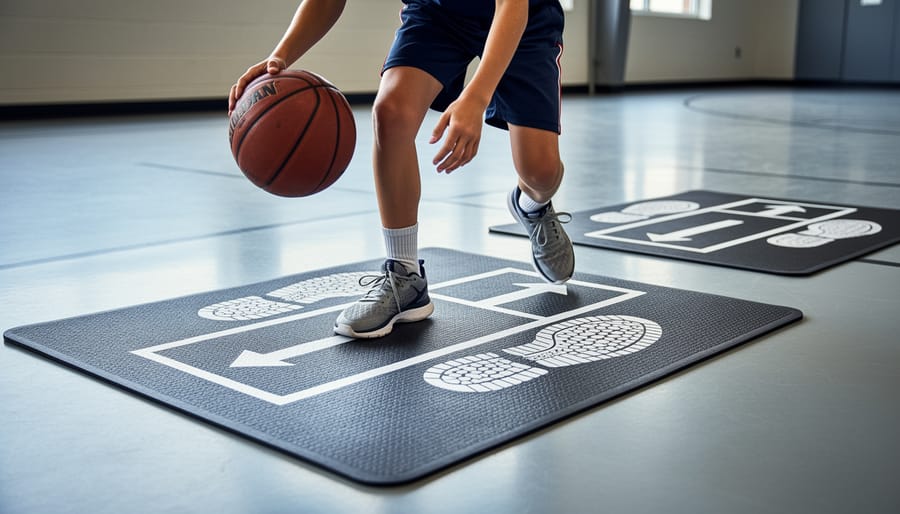
A basketball training mat earns its place in small spaces. For an individual player or a family, it gives a defined spot to work on dribbling, ball control and footwork without needing a driveway hoop or a gym booking. The listings reviewed reflect that purpose: the Amazon.ca product is listed at 40 x 35 x 3 cm, and the Walmart mat measures 23.62″ x 15.75″. Those are footprints made for a corner of a basement, not a playing area.
Here is how that trade-off plays out in practice:
Pros
Cons
Schools, clubs and municipal facilities face a different set of needs. Organized programs involve many athletes moving at full speed, which calls for permanent flooring, properly marked courts, hoops, seating and the supporting infrastructure that keeps everyone safe and play consistent. A mat can’t provide any of that, and it isn’t designed to.
That is where specialist infrastructure planning comes in. Facility operators and community organizations across Canada typically work with suppliers who can handle both the equipment and the installation, so the surface, hoops and layout suit the program from the start.
The two options work best side by side. A player can sharpen handles at home on a mat, then carry those skills onto a proper court built for the full game.
A basketball training mat is a small investment, and a few simple habits will keep it performing well drill after drill. Start with the basics: wipe the surface down with a damp cloth and mild soap after sweaty sessions, then let it dry completely before you put it away. Trapped moisture is the quickest route to odours and a mat that loses its grip.
Keep the mat away from prolonged moisture and direct heat. A sunny windowsill, a parked car or a radiator can warp or harden materials, and a damp basement corner invites mildew. Because some listings position mats for gyms while others suit driveways and home use, check the seller’s care guidance for your specific product, and ask directly if it isn’t stated.
Storage depends on the mat. Compact designs, like those measuring around 40 x 35 x 3 cm, are usually easy to stash flat under a bed or on a shelf. Follow the manufacturer’s advice before rolling any mat, since some materials crease. Before each session, sweep or wipe away grit, pebbles and dust so they don’t scuff the surface or send the ball bouncing off line.
If you’re weighing a larger setup, our guide to gym mat options covers other surfaces and how to store them.
No. A mat gives you a compact surface for dribbling, ball-handling and footwork in small spaces. It isn’t a substitute for a regulation court or a sprung facility floor.
The SilentBall Academy product page lists Canada as an available country and offers CAD as a currency option. Check the checkout page for current shipping details before you order.
The SilentBall Academy product page states a 30-day money-back guarantee. Read the full terms on the page before buying.
The Amazon.ca listing gives dimensions of 40 x 35 x 3 cm, and the Walmart listing gives a mat size of 23.62″ x 15.75″. Both are compact, so measure your drill space first.
Safety certifications weren’t confirmed in the research, so ask the seller directly about materials and any testing before you buy. Once you have the mat, a little planning helps it last. Our notes on equipment storage can help keep it clean and ready for the next session.
Pour les lecteurs francophones, les points clés de cet article sont également disponibles en français.
A basketball training mat is a practical tool for small-space skill work, as long as you choose it with care. Before buying, check that the stated dimensions fit your space, confirm whether the mat suits indoor floors or an outdoor driveway, and read the return policy, such as the 30-day money-back guarantee shown on one current kit page. Ask the seller directly about safety and materials information, since certifications could not be confirmed.
A mat helps with dribbling, ball-handling and footwork at home, but it does not replace a proper court. Schools, clubs and municipal facilities need durable flooring, courts and supporting infrastructure built for sustained, organized use. If you are planning for a larger program, start with those foundations, and treat a mat as a useful complement for individual practice.