Why America’s Sporting Goods Manufacturers Still Dominate the Global Market
- Home / Uncategorized / Why America’s Sporting Goods Manufacturers Still Dominate the Global Market
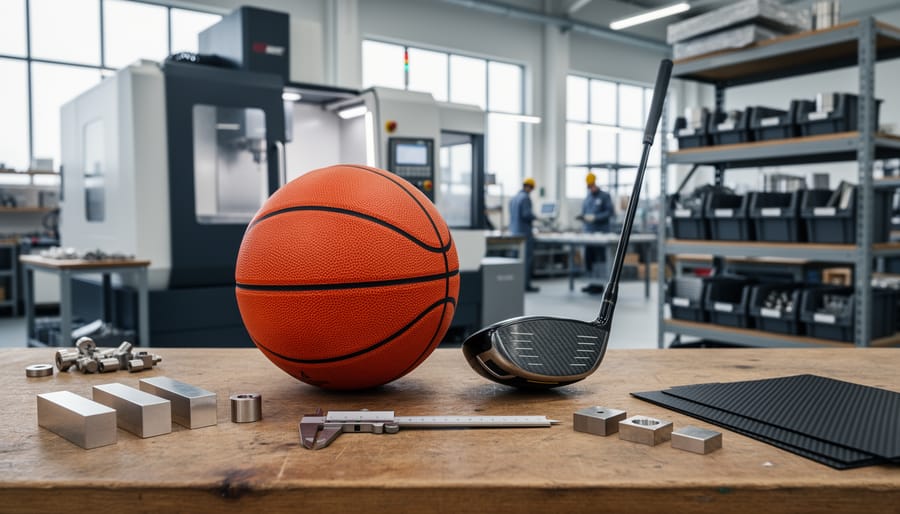
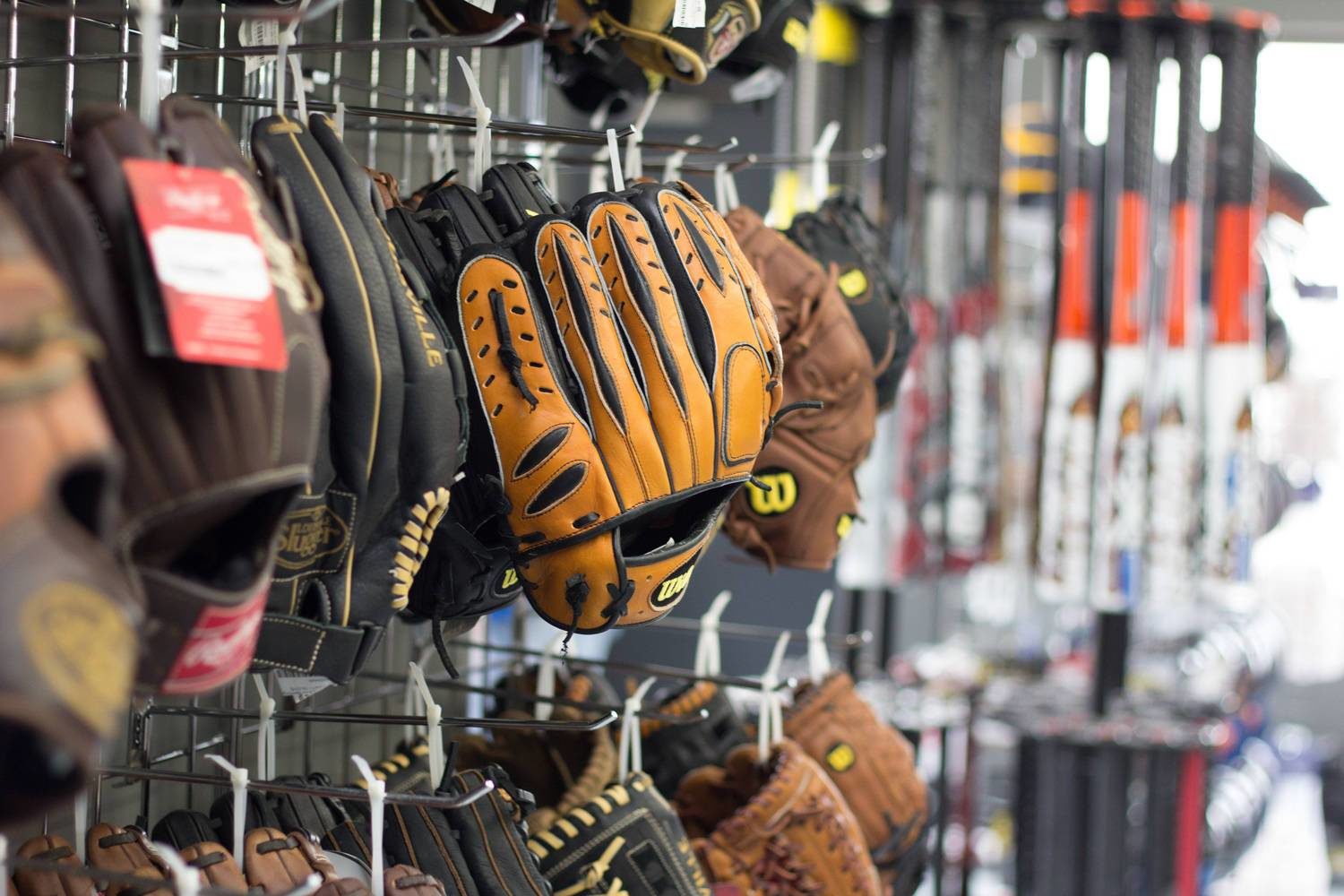
The United States houses more than 1,200 sporting goods manufacturers that collectively generate over $15 billion in annual revenue, offering facility operators and procurement professionals a deep bench of suppliers across virtually every sport category. American manufacturers dominate global markets in golf equipment, basketball gear, fitness systems, and specialized athletic products, combining advanced materials engineering with scalable production capabilities that few other countries can match.
For Canadian facility operators and international buyers evaluating American suppliers, the competitive advantage is clear. U.S. manufacturers benefit from proximity to major research institutions, access to aerospace-grade materials, and established quality control systems that meet stringent safety standards. Production facilities concentrated in the Midwest and Southeast typically offer shorter lead times for North American buyers than Asian alternatives, while currency exchange considerations can make U.S.-sourced equipment particularly attractive for Canadian procurement teams.
The landscape ranges from household brands producing millions of basketballs annually to specialized manufacturers serving niche markets like indoor golf simulators or commercial fitness installations. Understanding which manufacturers align with your facility’s needs requires knowing their core competencies, minimum order requirements, and distribution networks. Some work exclusively through dealer channels, while others maintain direct relationships with large facility operators and municipal buyers.
What sets American sporting goods manufacturing apart in 2026 is the industry’s increasing focus on sustainability and domestic supply chain resilience. Many manufacturers have reshored production previously handled overseas, responding to buyer demand for transparent sourcing and reduced shipping timelines. This shift benefits Canadian and international buyers seeking reliable partners who can adapt quickly to specification changes or custom requirements that large-volume overseas suppliers often can’t accommodate efficiently.
The American sporting goods manufacturing sector maintains a commanding position in the international market through specialized production capabilities and technological innovation. In 2026, the industry generates approximately $15.8 billion in annual production value, with significant portions dedicated to specialized categories that serve facility operators and sports organizations worldwide.
Golf equipment manufacturing represents the most substantial export-focused segment, leveraging precision engineering and performance technology that set global standards. Major production facilities concentrate in California, Arizona, and the southeastern United States, where manufacturers combine advanced materials research with rigorous testing protocols. Basketball equipment production centers around specialized court surface systems, goal assemblies, and training infrastructure designed for institutional installations rather than consumer retail. Adult fitness equipment manufacturing has expanded beyond traditional cardiovascular and strength machines to encompass complete facility systems, including commercial bleacher installations, multi-sport infrastructure, and integrated athletic training environments.
| Category | Annual Production Value | Export Percentage | Primary Markets |
|---|---|---|---|
| Golf Equipment | $4.2 billion | 42% | Canada, Japan, South Korea, Europe |
| Basketball Equipment | $1.8 billion | 28% | Canada, Mexico, China, Australia |
| Adult Fitness Equipment | $3.6 billion | 35% | Canada, Latin America, Middle East |
| Multi-Sport Infrastructure | $2.4 billion | 31% | Canada, Caribbean, Central America |
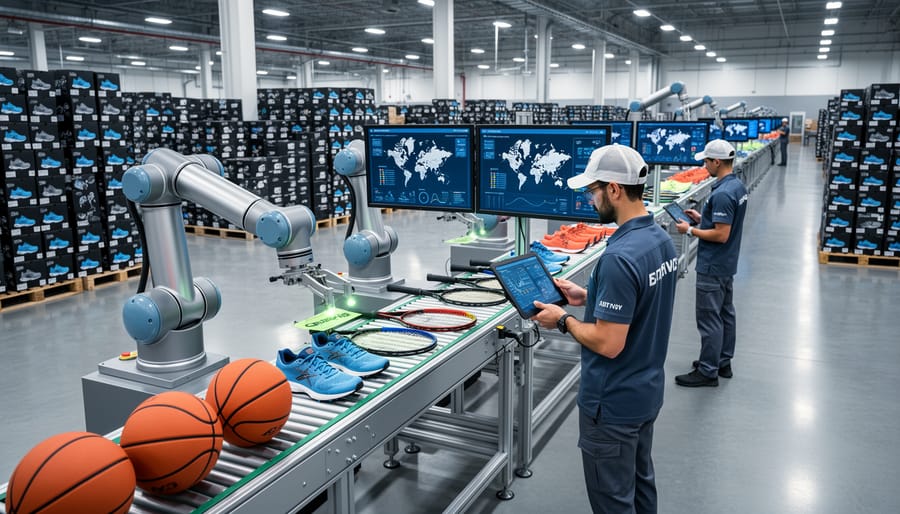
Current manufacturing trends reflect increased automation in production while maintaining specialized craftsmanship for high-performance components. Many manufacturers now operate hybrid facilities that combine robotic precision for standardized components with skilled technicians for custom installations and performance-critical assemblies. This approach allows American producers to compete on quality and customization rather than price alone.
The sector has consolidated around manufacturers who can serve institutional buyers with complete project solutions rather than individual product sales. This shift aligns with global market trends toward integrated facility procurement, where buyers prefer suppliers capable of coordinating full equipment packages with installation services and ongoing support. For Canadian facility operators, this means access to manufacturers who understand cross-border project requirements and can deliver turnkey solutions rather than disconnected equipment shipments.
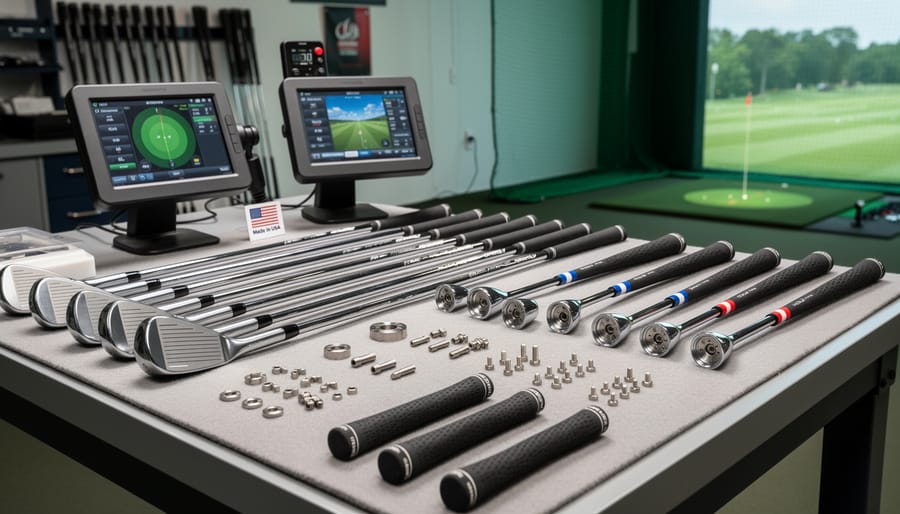
American golf equipment manufacturing remains concentrated among a handful of major players who set global standards for innovation and performance. Callaway Golf, headquartered in Carlsbad, California, leads with advanced club designs incorporating artificial intelligence-driven fitting systems and multi-material construction techniques. Their Paradym driver series exemplifies how USA manufacturers integrate aerospace-grade materials with computer modeling to optimize ball flight characteristics.
Titleist, operating from Massachusetts, maintains dominant market share in golf balls and continues expanding its club manufacturing footprint. The company’s ball-fitting technology and research facilities represent significant investments in product development that smaller manufacturers struggle to match. For golf course operators, Titleist’s tour validation process ensures consistent performance specifications across product lines.
Ping, based in Phoenix, pioneered adjustable weighting systems and custom fitting protocols now standard throughout the industry. Their manufacturing approach emphasizes precision engineering with tolerances measured in thousandths of an inch, particularly relevant for facility operators purchasing fleet sets where consistency matters.
These manufacturers maintain extensive dealer networks and service infrastructure across North America, simplifying warranty support and replacement parts for Canadian golf facilities. Their scale enables them to offer demo programs and fitting events that smaller brands cannot replicate.
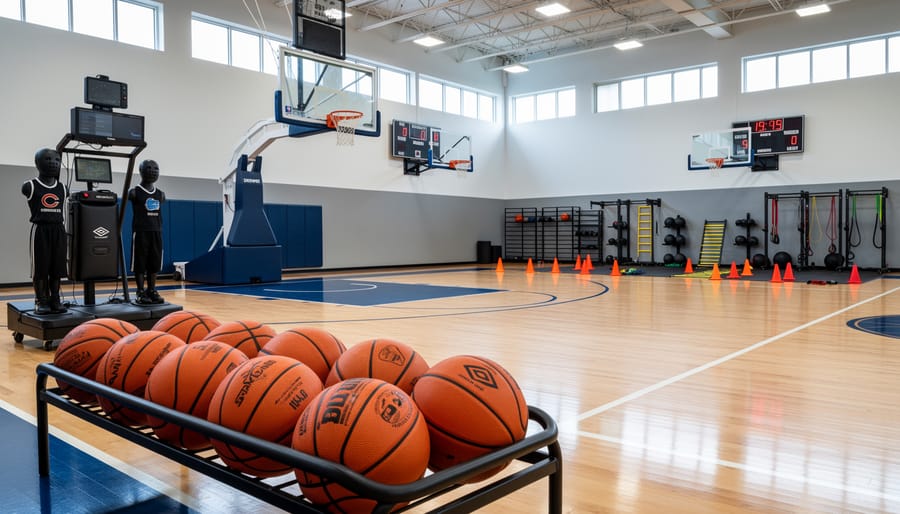
American manufacturers have established themselves as the primary suppliers of basketball infrastructure to facilities worldwide, delivering everything from regulation-quality hoops to complete court systems. Spalding, though recently acquired by international interests, maintains its USA manufacturing footprint and continues to produce basketball systems used in professional arenas and municipal gyms across North America. Their in-ground and wall-mounted hoop systems meet FIBA and NCAA specifications, making them a default choice for facility operators requiring certified equipment.
Gared Sports, headquartered in Noblesville, Indiana, specializes in institutional-grade basketball equipment specifically designed for heavy facility use. Their adjustable backstop systems and wall-mounted units withstand the demands of multi-purpose gymnasiums where basketball shares space with volleyball and other activities. The company’s engineering focuses on safety mechanisms and vandal resistance, critical considerations for publicly accessible facilities.
Court surface manufacturers like Sport Court and Connor Sports represent another crucial segment. Connor’s maple flooring systems, produced in Michigan, appear in hundreds of collegiate and professional venues. Sport Court’s modular tile systems offer Canadian facility operators a practical alternative for outdoor courts or multi-use spaces where traditional hardwood isn’t feasible. These American-made surfaces typically carry 15-year warranties and meet international sport surface standards, providing facility managers with documented performance specifications required for grant applications and insurance compliance.
The adult fitness and multi-purpose facility equipment segment showcases American manufacturing strength in durable infrastructure. Cybex International (acquired by Brunswick Corporation) produces commercial-grade strength and cardio equipment engineered for high-traffic institutional use, with robust warranties and service networks extending into Canadian facilities. Their machines withstand 24/7 operational demands that lighter residential equipment cannot match.
For bleacher and spectator seating infrastructure, Hussey Seating Company in Maine manufactures telescoping and fixed bleacher systems installed in arenas across North America. Their engineering addresses Canadian building codes and climate considerations, crucial for municipal facility managers planning long-term installations. Interkal Inc. provides similar American-made spectator seating with configurations suitable for multi-sport complexes.
In outdoor fitness infrastructure, American companies like TriActive USA manufacture permanent outdoor fitness equipment circuits that municipal parks departments increasingly favor over traditional playgrounds. These weather-resistant installations require minimal maintenance and serve adult populations seeking accessible fitness options.
The North American free-trade framework reduces tariff barriers on these bulky products, though transportation costs remain significant. Canadian facility operators benefit from proximity to USA factories for technical support and replacement parts, essential considerations when selecting infrastructure with 15-20 year expected lifespans.
American sporting goods manufacturers maintain their international market position through several interconnected competitive advantages that extend well beyond brand recognition.
Research and Development Investment
USA manufacturers allocate substantial resources to product innovation, typically investing 3-7% of annual revenue into R&D, significantly higher than manufacturers in many competing countries. This commitment produces measurable results in equipment performance. American golf club manufacturers, for instance, regularly introduce proprietary alloys and composite materials that improve ball distance and accuracy. Basketball equipment producers develop surface technologies that reduce joint impact while maintaining optimal ball response. These innovations emerge from dedicated engineering teams, often supported by university partnerships and athlete testing programs that provide real-world performance data before products reach sporting equipment stores internationally.
Manufacturing Quality Control
American facilities operate under stringent quality management systems that international buyers recognize as reliability indicators. Most major manufacturers maintain ISO 9001 certification as a baseline, with many implementing sport-specific standards like ASTM International specifications for particular equipment categories. This translates to consistent product performance across production runs, a critical factor for facility operators ordering matching equipment sets or replacement components years after initial installation. The quality control extends to supply chain oversight, with USA manufacturers typically maintaining tighter vendor specifications than required by international competitors.
Production Flexibility and Customization
USA manufacturing infrastructure supports customization at scales that benefit facility operators and institutional buyers. Unlike mass-production-focused facilities common in some international markets, American manufacturers retain capacity for custom orders, modified specifications, and branded equipment runs without prohibitive minimum order quantities. A municipal sports complex can order basketball systems with specific height adjustments, backboard materials, and safety padding configurations tailored to their program needs. This flexibility stems from manufacturing systems designed around varied product lines rather than single-item efficiency.
Workforce Specialization
American sporting goods production benefits from specialized labor with deep category expertise. Golf shaft manufacturers employ technicians who understand flex profiles and torque specifications at granular levels. Court surface specialists bring knowledge of polymer chemistry and athletic biomechanics. This expertise supports both product development and technical consultation, manufacturers can advise facility planners on equipment selection for programs serving active adults versus youth athletes, or recommend surface specifications for multi-use versus dedicated facilities.
Proximity to Major Markets
Geographic positioning near significant North American markets reduces lead times and simplifies logistics for Canadian and USA buyers, providing competitive timing advantages that Asian manufacturers struggle to match despite lower production costs.
Sourcing equipment from USA manufacturers offers Canadian facility operators access to premium products and competitive pricing, but successful procurement requires attention to specific cross-border considerations. Understanding these logistics, warranty implications, and compliance requirements ensures smooth transactions and long-term equipment performance.
Cross-Border Logistics and Duty Considerations
The USMCA trade agreement eliminates most tariffs on sporting goods manufactured in the United States, making American equipment particularly attractive for Canadian buyers pursuing cost-effective sourcing strategies. However, facility operators must still account for customs clearance procedures, which typically require proof of origin documentation from manufacturers. Shipping costs vary significantly based on equipment size and weight, while basketballs and smaller items ship economically via standard freight carriers, large installations like bleacher systems or court surfaces require specialized transportation that can add 15-25% to the base equipment cost.
Most established USA manufacturers work with Canadian customs brokers or freight forwarders experienced in sporting goods shipments, streamlining the border crossing process. Facility operators should clarify whether shipping quotes include delivery to the final installation site or only to the border, as domestic Canadian transportation from the entry point often becomes an unexpected expense.
Warranty Coverage and Service Networks
Warranty terms represent a critical consideration that facility operators frequently overlook until equipment issues arise. Many USA manufacturers extend full warranty coverage to Canadian customers, but service protocols differ. Some companies maintain authorized service centers in major Canadian markets, while others require shipping equipment back to US facilities for repairs, an approach that creates significant downtime for essential facility infrastructure.
Before finalizing large equipment purchases, request documentation specifying warranty duration, what the warranty covers (parts only versus parts and labour), response time commitments, and whether the manufacturer stocks replacement parts in Canada. Basketball hoop systems, fitness equipment, and court surfaces all have different service requirements, and manufacturers with established Canadian partnerships typically provide faster resolution.
Compliance and Safety Standards
Canadian facilities must ensure imported equipment meets applicable CSA standards and provincial safety regulations. Most reputable USA manufacturers design products to meet or exceed both US and Canadian requirements, but operators should verify compliance documentation rather than assume compatibility. This particularly matters for electrical fitness equipment, bleacher systems requiring structural certifications, and playground-adjacent sporting installations subject to safety surface standards.
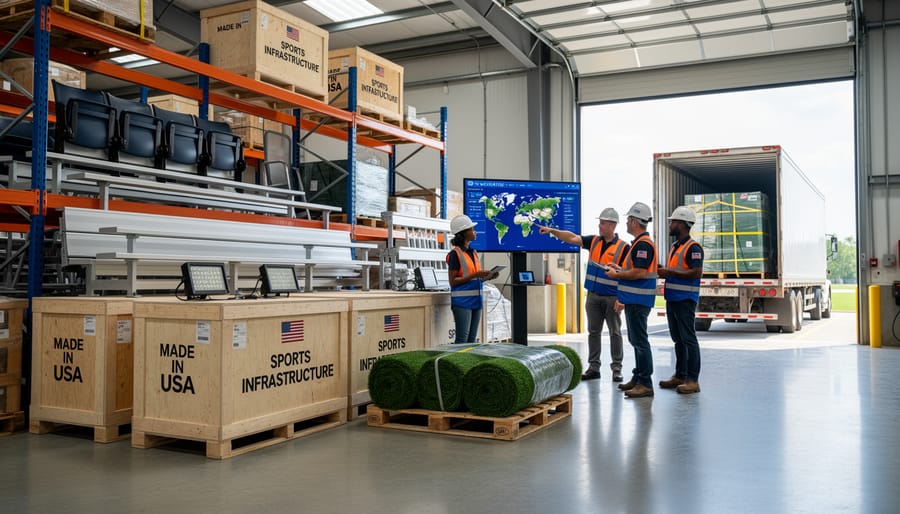
The integration of USA sporting goods manufacturers into the continental supply chain creates unique advantages for Canadian facility operators. Most major American manufacturers maintain distribution centers near the Canadian border, particularly in Michigan, New York, and Washington state, enabling faster delivery times and reduced shipping costs compared to overseas suppliers. This geographic proximity means you can often receive bulk equipment orders within days rather than weeks, a critical factor when replacing damaged court surfaces or fulfilling urgent facility needs before peak seasons.
USMCA (the United States-Mexico-Canada Agreement) eliminated most tariffs on sporting goods manufactured in North America, making American equipment more price-competitive for Canadian buyers. Unlike imports from Asia or Europe, qualifying USA-manufactured products enter Canada duty-free, though you still need to account for GST/HST and provincial sales taxes. Verify the product’s country of origin certification with your supplier, some “American brands” actually manufacture overseas, which affects duty calculations.
Cross-border warranty service represents another supply chain advantage. Leading USA manufacturers typically honor warranties across North America through their Canadian dealer networks, ensuring you receive parts and service support without international shipping complications. This becomes essential for complex installations like retractable bleacher systems or electronic scoreboards that may require manufacturer-authorized technicians.
The North American supply chain also supports hybrid procurement strategies. Many facility operators source new equipment directly from USA manufacturers while supplementing with 2nd-hand equipment from American institutions upgrading their facilities. This approach balances budget constraints with quality standards, particularly for municipal recreation centers serving multiple sports.
Currency fluctuations between the US and Canadian dollar affect purchasing power, so larger facility projects often benefit from forward contracts or phased ordering to manage exchange rate risk. Most established American suppliers understand these dynamics and offer pricing flexibility for substantial Canadian orders.
American sporting goods manufacturers have accelerated their sustainability efforts beyond compliance, driven by facility operators demanding measurable environmental credentials and supply chain transparency. This shift affects procurement decisions for international buyers who must balance performance requirements with institutional sustainability mandates.
Leading USA manufacturers now integrate recycled materials throughout their product lines, from reclaimed rubber in basketball court surfaces to post-consumer plastics in bleacher seating. Companies like Baden Sports and Spalding have reformulated basketballs using recycled rubber compounds that meet FIBA specifications while reducing virgin material consumption by 30-40%. For golf equipment, manufacturers increasingly use recycled carbon fiber in club shafts and reclaimed materials in range balls, responding to course operators tracking their environmental footprint.
Manufacturing innovation centers on water-based adhesives replacing solvent systems, powder coating processes that eliminate VOC emissions, and on-demand production reducing inventory waste. Several major manufacturers have implemented closed-loop water systems in their facilities, cutting consumption by up to 60% compared to traditional processes.
Energy efficiency drives facility upgrades across the sector. Solar installations now power portions of production at multiple USA sporting goods plants, while LED lighting retrofits and heat recovery systems reduce operational carbon emissions. These improvements matter for Canadian procurement offices tracking Scope 3 emissions from purchased goods.
Transportation innovations complement production changes. Some manufacturers offer consolidated shipping programs that combine orders from multiple Canadian facilities, reducing per-unit carbon footprint by 20-35%. Packaging redesigns using corrugated materials instead of foam and eliminating plastic wrap align with Canadian waste reduction targets while maintaining product protection during cross-border transit.
American sporting goods manufacturers maintain their position as essential partners for international facility operators and sports organizations through demonstrated excellence in innovation, quality standards, and reliable production capabilities. For Canadian buyers specifically, geographical proximity combines with established trade relationships to create natural advantages in logistics, service support, and collaborative partnerships.
When selecting USA manufacturers, facility operators should prioritize companies demonstrating proven track records in their specific equipment categories, comprehensive warranty and service networks extending across borders, and transparent communication about production timelines and customization capabilities. The most successful partnerships emerge when manufacturers understand the unique requirements of Canadian facilities, including climate considerations, bilingual documentation needs, and compliance with both American and Canadian safety standards.
Looking ahead, the integration of North American sporting goods markets will likely deepen as manufacturers adopt more sustainable production methods and digital technologies that streamline cross-border ordering and support. Canadian organizations can expect continued access to cutting-edge equipment innovations from USA producers while benefiting from strengthened supply chain resilience through regional manufacturing.
The fundamental value proposition remains clear: American sporting goods manufacturers offer international buyers, particularly Canadian facility operators, a combination of technical expertise, manufacturing scale, and market responsiveness that few global competitors match. Building strategic relationships with the right USA manufacturers positions sports facilities to deliver superior experiences for athletes and communities while maintaining equipment reliability and long-term value.