Basketball Specification: Official Standards and Technical Requirements for Courts, Hoops, and Equipment
- Home / Sports Facility Infrastructure / Basketball Specification: Official Standards and Technical Requirements for Courts, Hoops, and Equipment
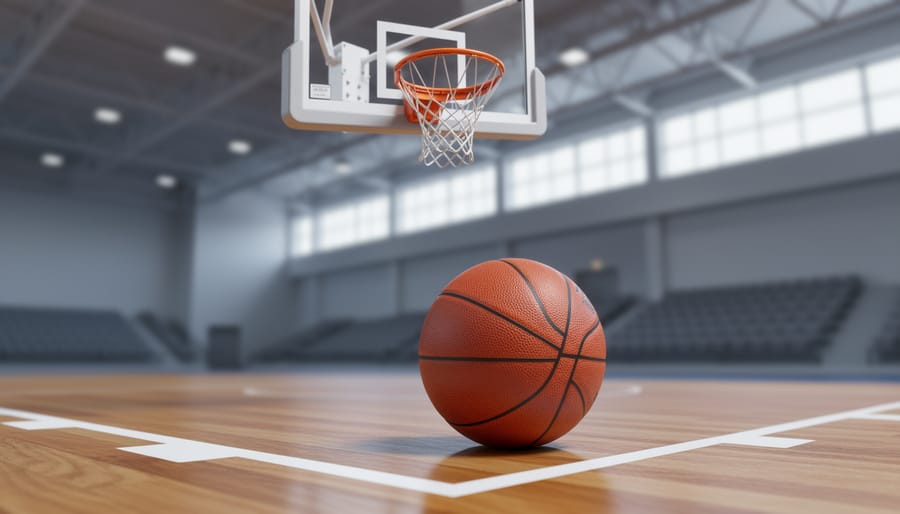
Basketball specifications follow universal standards established by governing bodies: regulation courts measure 94 feet by 50 feet (NBA/FIBA) or 84 feet by 50 feet (high school), hoops sit precisely 10 feet high with 18-inch diameter rims, and official game balls range from 29.5 to 29.9 inches in circumference for men’s play. These measurements aren’t arbitrary. They’re codified requirements that ensure fair competition, player safety, and equipment compatibility across facilities worldwide.
For facility operators and procurement officials in Canada, understanding these specifications is non-negotiable. Installing a basketball court or replacing equipment used for basketball requires adherence to standards set by organizations like FIBA (international play), the NBA (professional), and provincial sports governing bodies. A single miscalculation in rim height or three-point line distance can invalidate a facility for sanctioned competition.
The challenge extends beyond measurements alone. Material specifications, surface hardness ratings, backboard transparency standards, and even lighting requirements all factor into compliance. Canadian facilities face additional considerations: bilingual signage requirements in certain provinces, climate-controlled storage for equipment in harsh winters, and alignment with both imperial and metric measurement systems depending on the governing body.
This guide consolidates the technical specifications you need for informed procurement decisions. Whether you’re outfitting a municipal recreation center, upgrading a school gymnasium, or planning a competitive arena, the data presented here provides the baseline standards against which all basketball equipment and facilities must be measured in 2026.
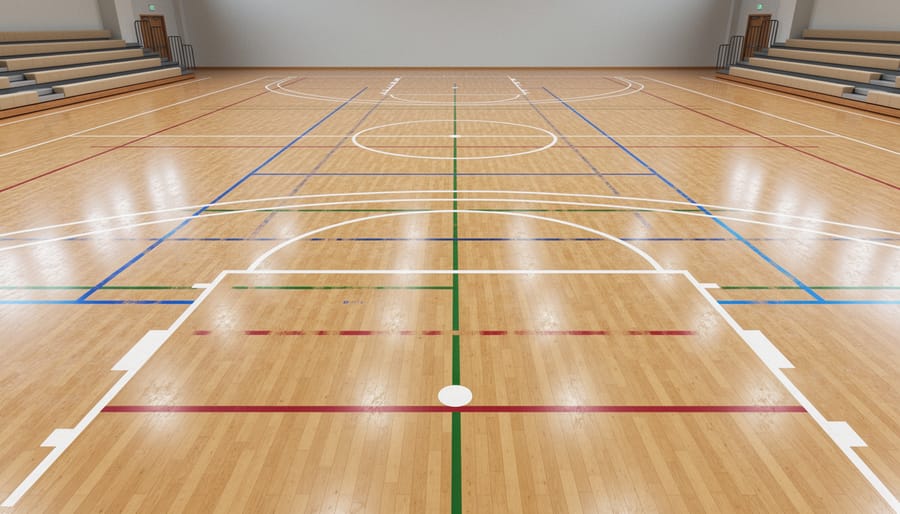
A regulation basketball court’s dimensions vary by governing body and level of play, but all follow strict geometric principles to ensure consistent gameplay. Understanding these measurements is crucial for facility operators planning new construction or validating existing courts.
FIBA International Standards
FIBA courts measure 28 meters long by 15 meters wide (91.9 feet by 49.2 feet). The center circle has a 3.6-meter (11.8-foot) diameter. The three-point arc extends 6.75 meters (22.15 feet) from the basket center, creating a uniform distance across the arc.
NBA Dimensions
NBA courts are 94 feet long and 50 feet wide. The center circle matches FIBA at 12 feet diameter, but the three-point line differs significantly: 23.75 feet (7.24 meters) from the basket at the arc’s top, narrowing to 22 feet in the corners where space constraints apply.
NCAA and High School Courts
NCAA men’s courts mirror NBA dimensions with a 94-by-50-foot layout. The three-point arc sits at 22.15 feet for men (matching FIBA) and 20.75 feet for women. High school courts typically measure 84 feet by 50 feet, with a 19.75-foot three-point arc, though some jurisdictions permit full-size courts.
Free-Throw Lane Specifications
The key (free-throw lane) measures 16 feet wide in FIBA play and 12 feet wide in NBA/NCAA formats, extending from the baseline to the free-throw line positioned 15 feet from the backboard. The lane includes marked spaces for player positioning during free throws.
Boundary lines must be 5 centimeters (2 inches) wide and clearly visible in contrasting colors to the court surface, forming the foundation for all other markings.
Basketball court surfaces must meet specific performance and safety standards regardless of material type. The primary surface options, hardwood, synthetic, and outdoor materials, each have distinct technical requirements that facility operators must understand when selecting and maintaining court flooring.
Hardwood Court Specifications
Maple hardwood remains the gold standard for indoor basketball facilities. FIBA and NBA regulations specify hard maple (Acer saccharum) as the preferred species due to its dense grain structure and consistent performance characteristics. The wood must be kiln-dried to 6-9% moisture content and installed over a resilient subfloor system. Boards should be 3.25 inches wide with a thickness of 21-23 mm. The surface requires a polyurethane finish meeting a coefficient of friction between 0.50 and 0.70 to prevent slipping while allowing controlled movement. Shock absorption must exceed 53% (measured as force reduction) to minimize player joint stress.
Synthetic Surface Standards
Synthetic courts use polyurethane, polypropylene, or modular tile systems. These surfaces must achieve similar friction coefficients (0.45-0.65) and shock absorption rates (45-55%) to hardwood. Point elasticity should measure between 0.6-1.2 mm under standard load testing. Many synthetic options incorporate closed-cell foam or rubber underlayment to enhance cushioning. The surface must demonstrate vertical ball rebound of 90-100 cm when a regulation basketball is dropped from 180 cm height.
Outdoor Court Materials
Asphalt and concrete outdoor courts require textured finishes to provide adequate grip in varying weather conditions. Acrylic sport coatings 3-5 mm thick are applied over sealed concrete to achieve friction values of 0.55-0.75. These coatings must resist UV degradation, temperature extremes (-40°C to +50°C in Canadian climates), and moisture penetration. Proper drainage slope (1-2% grade) prevents water pooling that compromises safety and surface longevity.
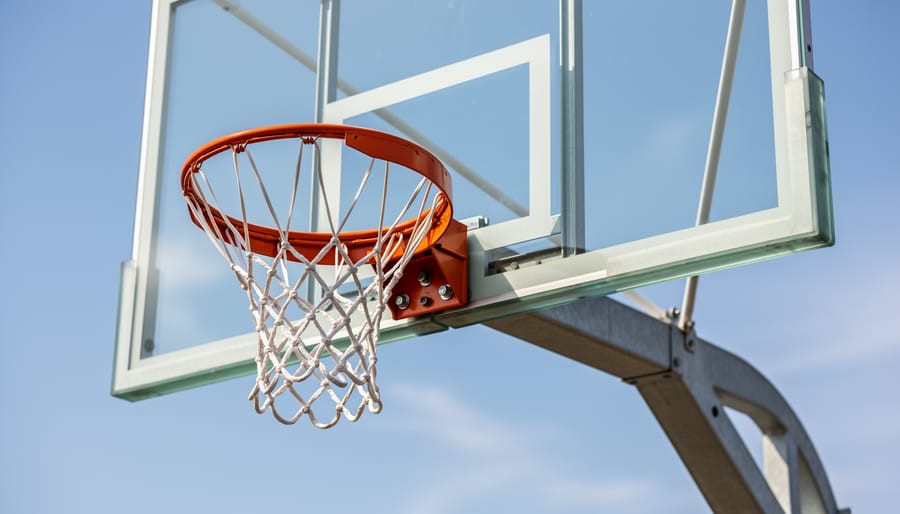
Regulation basketball rims must measure exactly 45.7 cm (18 inches) in interior diameter, positioned 3.05 meters (10 feet) above the playing surface. The rim itself consists of solid steel construction with a minimum diameter of 5/8 inch, forming a complete circle with a net attachment mechanism along the bottom edge. Modern breakaway rims incorporate spring-loaded mechanisms that allow the rim to bend downward under force and return to position, reducing stress on backboards and minimizing injury risk during dunking. FIBA and NBA standards require breakaway rims for competitive play, though fixed rims remain acceptable for recreational facilities and youth installations.
Nets attach to the rim through 12 evenly-spaced loops and must measure between 40-45 cm (15-18 inches) in length. White cord nets remain standard, though teams may use colored nets for branding. The net should create sufficient drag to momentarily slow the ball after a score, providing visual confirmation without impeding play. Regulation nets use braided nylon or polyester construction with 5mm diameter cord, resistant to outdoor conditions and repeated use.
For complete facility compliance, rims integrate with proper hoop and backboard gear including mounting brackets rated for dynamic loading. Commercial installations require rims tested to withstand 230 pounds of static load and repeated impact cycling. Outdoor facilities need corrosion-resistant powder coating and stainless steel hardware. Facility operators should verify breakaway mechanisms function properly during annual inspections and replace nets showing significant wear or UV degradation.
Regulation backboards measure 72 inches wide by 42 inches high (approximately 183 cm by 107 cm), though smaller options exist for recreational and residential installations. The target square, the rectangle marked on the backboard above the rim, measures 24 inches wide by 18 inches high, positioned with its lower edge 11 inches above the rim.
Material Choice and Performance
Tempered glass delivers professional-grade performance with superior ball response and consistent rebound characteristics. FIBA and NBA regulations mandate tempered glass for competitive play, with thickness ranging from 10 mm to 12 mm. The glass provides optimal visibility for spectators and players while maintaining structural integrity under repeated impact.
Acrylic backboards offer excellent rebound performance at a lower cost than tempered glass. These typically measure 0.5 inches (12.7 mm) thick for regulation installations and provide good transparency. Acrylic suits institutional facilities balancing performance requirements against budget constraints.
Polycarbonate represents the most durable option, resisting breakage and weathering better than glass or acrylic. While it offers slightly less consistent ball response, polycarbonate works well for outdoor courts, schools with younger players, and high-vandalism environments. Standard thickness ranges from 0.375 to 0.5 inches.
Mounting and Support Specifications
All backboard materials require rigid mounting systems capable of handling dynamic loads during play. Support structures must anchor the backboard 4 feet from the baseline, positioning the rim at the regulation 10-foot height. Padding at least 2 inches thick must cover support poles and backboard edges within playing areas, extending from the floor to a minimum height of 7 feet.
Facility operators purchasing equipment from balls to hoops should specify material choice based on usage intensity, budget, and indoor versus outdoor installation requirements.
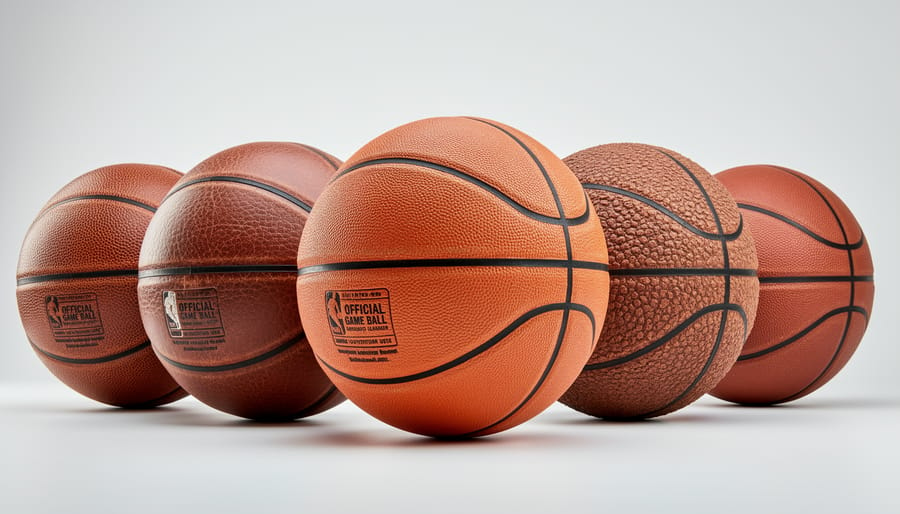
Regulation basketballs come in seven standardized sizes, each designed for specific age groups and competition levels. Understanding these distinctions helps facility operators stock appropriate equipment and ensures organizations comply with governing body requirements.
Men’s Basketball (Size 7) is the standard for professional, collegiate, and high school boys’ play. It measures 29.5 to 29.875 inches (74.9 to 75.9 cm) in circumference and weighs 20 to 22 ounces (567 to 624 grams). FIBA, NBA, and NCAA all mandate Size 7 for men’s competitions.
Women’s Basketball (Size 6) measures slightly smaller at 28.5 to 28.875 inches (72.4 to 73.3 cm) in circumference with a weight of 18 to 20 ounces (510 to 567 grams). This size applies to women’s professional leagues, NCAA women’s basketball, and FIBA women’s competitions, as well as boys aged 12-14.
Youth Basketball (Size 5) serves children aged 9-11 and measures 27.25 to 27.75 inches (69.2 to 70.5 cm) in circumference, weighing 14 to 16 ounces (397 to 454 grams). Many recreational programs and school physical education classes use this size for appropriate skill development.
Mini Basketball (Size 3) is designed for children aged 4-8, with a circumference of 22 to 22.5 inches (55.9 to 57.2 cm) and weight of 10 to 11 ounces (283 to 312 grams). Smaller sizes exist for toddler programs but lack universal standardization across governing bodies.
Basketball construction materials directly affect performance characteristics and durability. The three primary materials used in regulation basketballs are leather, composite leather, and rubber, each with distinct specification requirements.
Leather basketballs must use full-grain leather with a minimum thickness of 1.5mm. Professional leagues specify top-grain leather treated for consistent moisture absorption, which improves grip during play. The leather surface requires a pebbled texture with raised patterns measuring 0.5-0.8mm in height to ensure proper grip.
Composite leather balls combine synthetic materials with leather characteristics. These must meet the same pebble depth requirements as leather but typically feature a polyurethane coating. High-quality composite balls include moisture-wicking channels and must maintain grip consistency across temperature ranges from 15°C to 35°C.
Rubber basketballs designed for outdoor use require UV-resistant compounds that prevent cracking and fading. The rubber must maintain elasticity between -10°C and 40°C, making them suitable for Canadian outdoor facilities year-round.
Bounce height specifications are critical across all materials. When dropped from 1.8 meters onto a hardwood surface, regulation basketballs must rebound between 1.2 and 1.4 meters. This 67-78% bounce coefficient ensures consistent ball behavior during play.
Inflation pressure standards require 7-9 PSI (0.48-0.62 bar) for all regulation balls. Overinflation reduces grip and control, while underinflation affects bounce consistency and can cause irregular flight patterns during shooting.
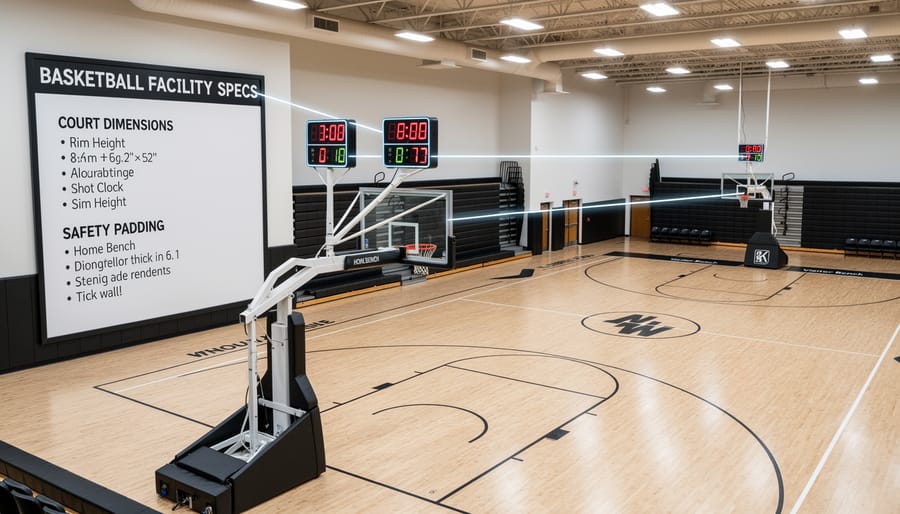
Beyond courts, hoops, and balls, a regulation-compliant basketball facility requires several supporting equipment items with their own technical specifications. These elements ensure player safety, accurate timekeeping, and proper game administration across all levels of play.
Scoreboards and Shot Clocks
Shot clocks are mandatory for competitive play above recreational levels. FIBA requires a 24-second shot clock with displays visible from all areas of the court, typically measuring 35-40 cm in height with LED digits. The clock must reset automatically to 24 seconds on change of possession and to 14 seconds on offensive rebounds in FIBA play. NCAA regulations specify similar visibility requirements but different reset protocols. Scoreboards must display period number, game time, team scores, and fouls, with minimum digit heights of 20 cm for primary scoring displays. Many Canadian facilities install combination units that integrate shot clocks with main scoreboards for cost efficiency.
Safety Padding Specifications
Wall padding is required wherever the court boundary sits within 3 meters of a wall or obstruction. Padding must extend from floor level to a minimum height of 2 meters, with 5 cm thickness for walls and 10-15 cm for structural columns. The padding surface requires vinyl or similar non-abrasive covering in contrasting color to the wall. Pole padding for adjustable or portable systems needs 10 cm minimum thickness with flame-retardant materials meeting CAN/ULC-S102 standards in Canadian jurisdictions.
Player Benches and Scorer’s Tables
Team benches must accommodate 12-15 people with seating positioned 2-5 meters from the sideline. Scorer’s tables require 4-6 meters of length with provisions for scorekeepers, timers, and statisticians. Tables should sit courtside at center court with integrated wiring for electronic equipment.
Additional Items
Compliant facilities also need regulation warm-up balls (same size specifications as game balls), ball racks or carts holding 10-15 balls, possession arrows for jump ball situations, and whistle-activated horn systems synchronized with game clocks. Many of these basketball equipment items are available in packages from Canadian suppliers who understand multi-use facility requirements and can coordinate specifications across different governing body standards.
Canadian facility operators face unique considerations when implementing basketball specifications, balancing compliance with budget constraints and multi-use space requirements. Most municipal facilities and community centres serve multiple sports and age groups, requiring flexible equipment solutions that meet various governing body standards while maximizing facility utilization and return on investment.
When budgeting for specification-compliant equipment, separate critical requirements from enhancement features. Court dimensions, surface friction coefficients, and breakaway rim mechanisms directly impact player safety and competitive fairness, these warrant immediate investment. Backboard material upgrades from polycarbonate to tempered glass or premium scorer’s tables can follow as budget permits, particularly if your facility primarily hosts recreational play rather than high-level competition.
Multi-use facilities should specify adjustable equipment wherever possible. Ceiling-mounted retractable hoops allow quick transitions between basketball and other sports, while adjustable-height systems accommodate youth leagues using smaller balls without compromising regulation standards for adult play. Ensure your facility compliance checklist includes verification that all height-adjustment mechanisms meet safety standards and include secure locking features.
Partner with suppliers who understand Canadian building codes and CSA standards alongside basketball-specific requirements. Request installation documentation showing compliance with manufacturer specifications, particularly for floor anchoring systems and structural support for wall-mounted or ceiling-suspended equipment. Many provinces require professional engineering sign-off for major installations, so confirm this requirement early in your planning process.
Establish a specification verification protocol before final payment. Measure court dimensions, test rim breakaway mechanisms, verify backboard materials match specifications, and confirm all safety padding meets thickness and density requirements. Document everything with photographs and measurements, this protects your organization if compliance questions arise later and provides valuable records for maintenance planning and future equipment upgrades.
Facility operators and organizations routinely encounter specification-related questions when purchasing, installing, or maintaining basketball equipment. Understanding these common concerns helps ensure informed decisions that balance compliance, budget, and user needs.
The primary differences are the three-point arc distance (6.75 meters for FIBA vs. 7.24 meters for NBA) and the lane width (4.9 meters for FIBA vs. 4.88 meters for NBA). NBA courts are also slightly longer at 28.65 meters compared to FIBA’s 28 meters.
Outdoor courts can use modified dimensions and materials suited to weather exposure, but should maintain proper proportions and key measurements like rim height (3.05 meters) and free-throw distance (4.57 meters from the backboard). Many outdoor facilities use scaled-down dimensions for recreational play while meeting these core standards.
Conduct thorough inspections at least annually for recreational facilities and before each season for competitive venues. High-use facilities should perform monthly checks on rim breakaway mechanisms, backboard stability, and court surface integrity.
Youth facilities should use age-appropriate specifications including lower rim heights (2.44-2.74 meters for younger players) and smaller basketballs, but should still maintain proper court proportions and safety standards. Professional-grade materials aren’t mandatory, though durability and safety features remain essential.
Specification flexibility varies by level of play and facility purpose. Recreational and community centres have more latitude with equipment choices than competitive venues hosting sanctioned games. However, certain safety standards, properly secured backboards, breakaway rims in facilities with players over 12 years old, adequate court surface shock absorption, apply universally regardless of play level.
Canadian facility operators often ask whether multi-use gymnasiums require full compliance with basketball specifications. The answer depends on programming: facilities hosting league play or tournaments need regulation measurements for those specific areas, while general-use spaces can accommodate modified layouts. Many operators solve this by installing adjustable systems that meet regulation height when needed but accommodate other activities.
Budget constraints frequently drive questions about specification priorities. Focus investment on safety-critical elements first: secure mounting systems, breakaway rims for appropriate age groups, and adequate court surface padding. Aesthetics like professional-grade hardwood or glass backboards, while desirable, rank lower than structural integrity and player safety. Phased upgrades allow facilities to improve gradually while maintaining baseline compliance for their intended use level.
Adhering to proper basketball specifications isn’t just about checking regulatory boxes, it directly impacts player safety, competitive fairness, and your facility’s reputation. Courts, hoops, and equipment built to governing body standards reduce injury risk, ensure consistent play experiences, and demonstrate your organization’s commitment to quality athletics. When specifications fall short, you risk everything from liability concerns to frustrated users who question your facility’s credibility.
For Canadian facility operators and municipal governments, meeting these standards presents unique considerations. Multi-use spaces, climate variations, and budget constraints require careful planning, but cutting corners on specifications creates long-term problems that far exceed initial savings. Experienced suppliers and installers who understand both international standards and Canadian market realities become invaluable partners. They help navigate the choices between FIBA, NBA, and high school specifications, recommend appropriate materials for your climate and usage patterns, and ensure installations meet safety codes.
The investment in specification-compliant equipment pays dividends through extended lifespan, reduced maintenance costs, and enhanced user satisfaction. Whether you’re building a new facility, upgrading existing courts, or replacing aging equipment, assessing your current setup against the standards outlined in this guide provides a clear roadmap forward.
Take time to evaluate your basketball facilities against these technical requirements. Identify gaps, prioritize upgrades based on safety and usage patterns, and consult with qualified suppliers who can deliver compliant solutions tailored to your specific needs and budget.