What Equipment Is Used for Basketball: Essential Gear from Balls to Hoops
- Home / Uncategorized / What Equipment Is Used for Basketball: Essential Gear from Balls to Hoops
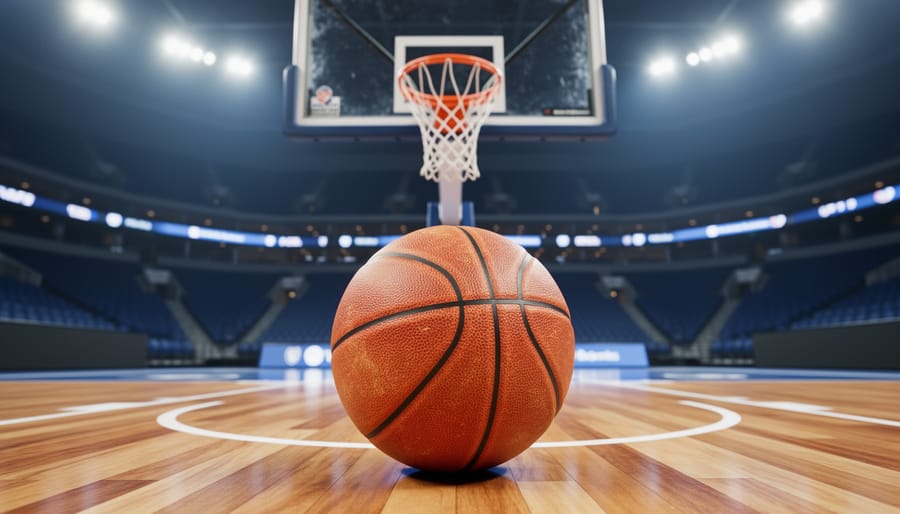
Basketball requires three categories of equipment: player gear (shoes, apparel, protective items), core playing equipment (balls, hoops, shot clocks), and facility infrastructure (courts, scoreboards, seating). Whether you’re an athlete stocking your gym bag or a facility manager planning a new installation, understanding these specifications ensures safe play and regulatory compliance across recreational and competitive settings.
The essential basketball equipment list has expanded beyond the traditional ball and hoop. Modern facilities in Canada now balance FIBA and NBA standards, particularly important for multi-use venues hosting international competitions alongside local leagues. Player safety equipment has become standard rather than optional, with ankle braces and mouthguards gaining widespread adoption at youth and adult levels.
For facility operators, equipment decisions carry long-term financial and operational implications. A regulation basketball system installed today will serve your community for 15 to 20 years, making upfront research critical. Court surfacing, lighting systems, and spectator amenities all require careful specification to meet current building codes and accessibility standards.
This guide breaks down each equipment category with the technical detail facility planners need and the practical context players want. You’ll find dimensional requirements, material specifications, and purchasing considerations that address both immediate setup and long-term maintenance across Canadian climate conditions.
The basketball itself forms the fundamental piece of equipment for the sport, and selecting the right ball depends on player age, skill level, and playing environment. Three official sizes dominate the market, each designed for specific demographics and competitive levels.
Size 7 basketballs measure 29.5 to 30 inches in circumference and weigh 20 to 22 ounces, serving as the standard for men’s professional and college leagues including NBA and FIBA competitions. Size 6 balls (28.5 to 29 inches circumference, 18 to 20 ounces) are used in women’s professional leagues and youth programs for players aged 12 and older. Size 5 basketballs (27.5 to 27.75 inches, 14 to 16 ounces) suit younger players aged 5 to 11, providing better control for developing skills.
| Size | Circumference | Weight | Primary Use |
|---|---|---|---|
| Size 7 | 29.5-30 inches | 20-22 oz | Men’s professional, college, ages 15+ |
| Size 6 | 28.5-29 inches | 18-20 oz | Women’s professional, youth 12-14 |
| Size 5 | 27.5-27.75 inches | 14-16 oz | Youth ages 5-11, skill development |
Material composition significantly affects performance and durability. Leather basketballs offer superior grip and feel, making them the choice for professional indoor competition, but they require a break-in period and deteriorate quickly on rough outdoor surfaces. Composite leather balls blend synthetic materials to provide consistent performance across temperature ranges while maintaining good grip, making them popular in Canadian facilities where climate control varies. Rubber basketballs withstand outdoor elements and abrasive indoor vs outdoor surfaces but sacrifice some control and bounce consistency.
Proper inflation matters for performance and safety. Basketballs should maintain 7.5 to 8.5 PSI, tested by dropping the ball from 6 feet; a correctly inflated ball bounces 49 to 54 inches high. This specification appears on most facility and player checklists for equipment maintenance.
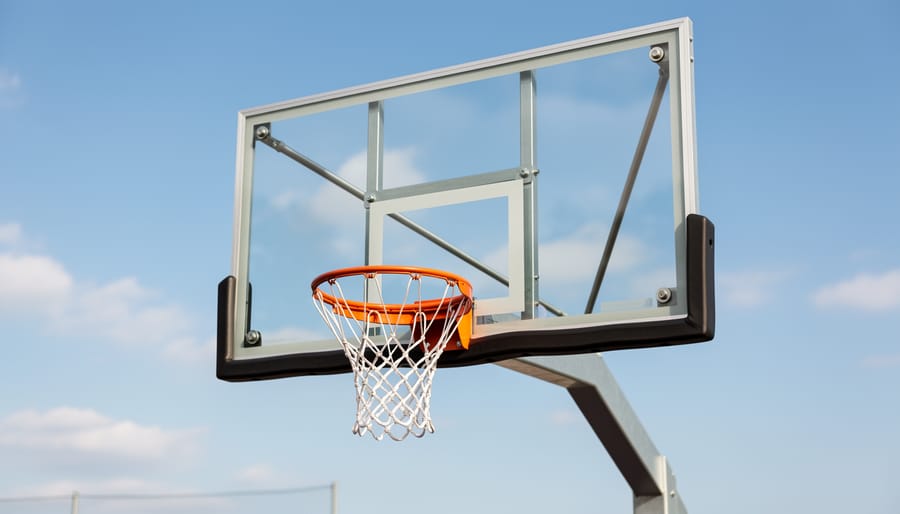
Basketball goals consist of three interconnected components: the rim, net, and backboard. Regulation rims measure 18 inches in diameter and mount 10 feet above the playing surface, with nets suspended below to provide visual feedback when shots pass through. Understanding these specifications helps facility operators and purchasers select appropriate systems for their intended use level.
Backboards come in three primary materials, each with distinct performance characteristics. Tempered glass backboards, sized 72 inches wide by 42 inches tall for regulation competition play, deliver the truest ball rebound and represent the professional standard for indoor facilities. Acrylic backboards offer good rebound consistency at a lower price point and work well for both indoor and outdoor recreational installations. Polycarbonate backboards provide the most durability and impact resistance, making them ideal for outdoor public courts and high-traffic areas where vandalism concerns exist. Smaller backboard dimensions like 60″ x 36″ or 54″ x 32″ suffice for residential and youth applications.
Rim construction divides into breakaway and fixed types. Breakaway rims feature spring-loaded mechanisms that flex downward under pressure during dunks, then return to position, reducing stress on the backboard and mounting structure while improving player safety. These rims are standard for competitive indoor facilities. Fixed rims attach rigidly to the backboard and cost less but don’t absorb impact forces, making them suitable only for recreational outdoor courts where dunking occurs infrequently.
Mounting systems determine installation flexibility and court configuration options. Wall-mounted systems attach directly to structural walls, offering a space-efficient solution for facilities with limited ceiling height or where floor space is premium. Ceiling-suspended goals hang from roof structures using adjustable-length supports, allowing precise height positioning and enabling courts to accommodate multiple age groups through electric or manual height adjustment mechanisms. Portable systems on wheeled bases provide maximum flexibility for multi-purpose facilities, though they require adequate floor space behind the baseline and proper counterweight ballast for stability. Outdoor installations typically use in-ground posts set in concrete footings, with pole diameters ranging from 4 to 6 inches for institutional-grade systems that withstand Canadian freeze-thaw cycles and wind loads.
Basketball court surfaces directly impact player performance, injury prevention, and facility maintenance costs. The flooring choice depends on whether the court is indoor or outdoor, the competition level, budget constraints, and climate considerations.
Hardwood maple remains the professional standard for indoor basketball courts. This material offers consistent ball bounce, excellent traction, and natural shock absorption that reduces joint stress during jumping and cutting movements. High-quality maple systems typically include a subfloor with cushioning properties that provide additional impact protection. These courts require controlled humidity environments and regular refinishing every 8-10 years, making them best suited for dedicated indoor facilities with climate control.
Synthetic surfaces present a cost-effective alternative for multi-purpose gymnasiums and community centres. Modern synthetic options include polyurethane sport surfaces and modular polypropylene tiles. These materials deliver good shock absorption and require less maintenance than hardwood, though they may produce different ball bounce characteristics. Synthetic surfaces handle temperature fluctuations better than hardwood, making them practical for facilities where climate control varies seasonally.
Modular tile systems offer flexibility for temporary or multi-use spaces. These interlocking tiles install quickly without adhesives, allow for easy repairs by replacing individual tiles, and provide adequate performance for recreational play. They work well in facilities that convert spaces between different sports or activities.
Outdoor courts typically use asphalt or concrete bases with acrylic sport coatings. Asphalt provides better shock absorption than concrete but requires more frequent resurfacing. Both materials withstand Canadian freeze-thaw cycles when properly installed with appropriate drainage systems. Acrylic coatings improve traction and reduce surface temperature during summer months while allowing for court line marking and colour customization.
Basketball shoes are engineered with specific features that directly impact performance, injury prevention, and comfort on the court. Understanding these specifications helps players select footwear matched to their position and playing style.
Ankle Support and Cut Height
Basketball shoes come in three cut heights, each serving different needs. High-tops extend above the ankle, providing maximum support and stability, traditionally favored by centers and power forwards who make frequent contact and need added protection during rebounds and post play. Mid-tops offer a balance between mobility and support, suiting versatile forwards and guards who need lateral quickness without sacrificing ankle reinforcement. Low-tops prioritize speed and range of motion, preferred by point guards and shooting guards who rely on rapid direction changes and minimal weight.
Cushioning Systems
Modern basketball shoes incorporate various cushioning technologies to absorb impact forces from jumping and landing. Common systems include foam compounds (EVA, polyurethane), air or gel capsules, and responsive materials that return energy. Heavier players typically benefit from maximum cushioning for shock absorption, while lighter, quicker players may prefer firmer, more responsive setups that enhance court feel and acceleration.
Traction Patterns and Outsole Design
The outsole pattern determines grip and directional control. Herringbone patterns offer multidirectional traction suitable for most playing styles, while circular or hexagonal patterns emphasize pivot movement. Rubber compound hardness affects both durability and grip, softer rubber grips better on indoor hardwood but wears faster, while harder compounds suit outdoor courts. Tread depth and spacing must prevent dust accumulation that reduces traction during play.
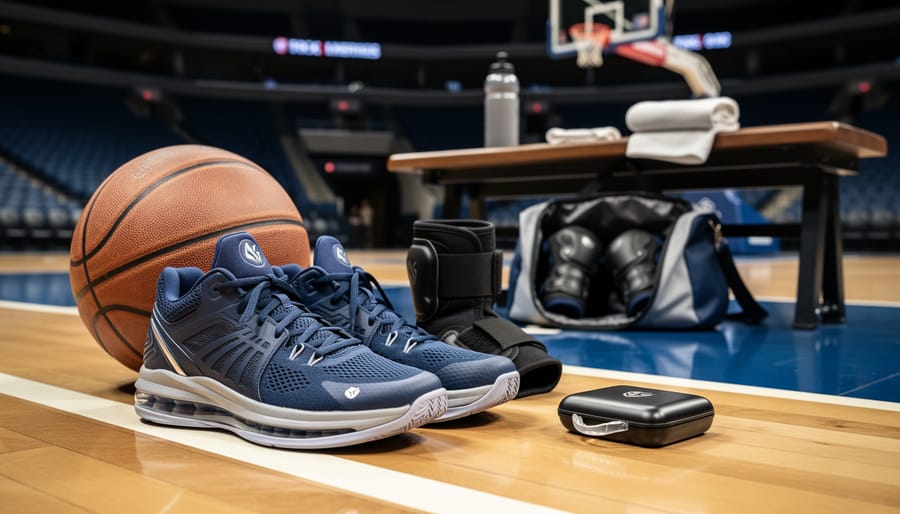
Basketball apparel combines performance fabric technologies with protective elements to enhance player safety and comfort during play. Standard uniforms consist of mesh jerseys and shorts constructed from polyester-based materials engineered for moisture-wicking, drawing sweat away from skin to the fabric surface where it evaporates quickly. Most jerseys weigh 140-180 grams and feature mesh panels for ventilation, while shorts typically include elastic waistbands with drawstrings and 9-11 inch inseams.
Compression wear, worn beneath or instead of standard uniforms, provides muscle support through graduated compression fabrics (typically 15-20 mmHg pressure). These garments reduce muscle vibration during movement and may help maintain body temperature, though players choose them primarily for comfort and perceived performance benefits.
Protective equipment addresses specific injury risks but isn’t universally mandated. Knee pads shield against floor impact, particularly valuable for players who frequently dive for loose balls. They’re constructed from foam padding (EVA or gel) encased in elastic sleeves, available in slip-on or strap designs. Ankle braces, lace-up, sleeve-style, or rigid stirrup types, provide lateral ankle support to reduce sprain risk, especially for players with previous ankle injuries.
Mouthguards protect teeth and reduce concussion severity during contact, though they’re recommended rather than required in most basketball leagues. Custom-fitted versions offer superior protection and comfort compared to boil-and-bite models. Understanding these player gear essentials helps athletes select appropriate equipment for their playing style and injury history.
Training aids help players develop specific skills and athletic capabilities beyond basic gameplay. Dribbling goggles restrict downward vision to force players to keep their heads up while handling the ball. These typically feature adjustable straps and lightweight plastic frames that fit over most face shapes.
Resistance bands for basketball training come in various resistance levels (light, medium, heavy) and typically measure 41 to 48 inches in length when unstretched. Latex and fabric-covered bands offer different durability and grip characteristics, with fabric options reducing slippage during explosive movements.
Agility cones and ladder drills equipment helps develop footwork and change-of-direction speed. Standard disc cones measure 2 inches in height and 7 to 9 inches in diameter. Agility ladders range from 15 to 30 feet in length with adjustable rung spacing, usually constructed from durable nylon webbing with plastic rungs.
Training vests, both weighted and mesh scrimmage types, serve different purposes. Weighted vests typically add 10 to 40 pounds through removable weight packets. Scrimmage vests use breathable mesh polyester in standard youth and adult sizes for practice organization.
Shooting aids include form correction sleeves, arc trainers that attach to hoops, and return nets that catch made shots for continuous practice.
Basketball facilities require seating solutions that balance spectator capacity with safety, space efficiency, and regulatory compliance. The choice of bleacher system depends on venue size, usage patterns, and whether the space serves multiple sports or functions.
Capacity and Configuration
Bleacher capacity ratings indicate the number of spectators based on standard seat width (typically 18 inches per person) and row depth. Systems range from compact 3-row units seating 30-50 people for small gyms to stadium-style configurations seating hundreds or thousands. Capacity calculations must account for aisle spacing and accessibility requirements.
Materials and Construction
Aluminum bleachers offer lightweight durability and corrosion resistance, making them suitable for facilities with high humidity or temperature fluctuations. Steel systems provide greater structural strength for high-capacity installations but require powder coating or galvanization to prevent rust. Both materials must meet load-bearing specifications for continuous and concentrated loads.
System Types
Telescoping (retractable) bleachers fold against walls when not in use, maximizing floor space for multi-purpose facilities. They operate manually, electrically, or hydraulically. Fixed bleachers remain permanently in place and typically cost less but occupy dedicated space. Portable units on wheels suit smaller venues needing occasional seating.
Safety and Compliance
In Canada, bleacher installations must comply with provincial building codes and CSA standards covering guardrail heights (typically 42 inches), aisle widths, footboard gaps, and structural loading. ADA compliance requires wheelchair spaces with companion seating, typically at a ratio of one accessible space per 25-50 seats, positioned with sight lines equivalent to standard seating.
Basketball scoreboards typically feature LED or LCD displays, with LED technology offering superior brightness and visibility from distance. Standard scoreboards show game score, period, time remaining, team fouls, and possession indicators. For competitive facilities, shot clocks (24 seconds in professional play, 30 seconds in some Canadian high school leagues) are essential separate units or integrated displays positioned above each basket.
Control systems range from wired consoles at the scorer’s table to wireless tablets and smartphones, with wireless options providing flexibility for operators to move around the facility. Modern systems integrate multiple functions, scorekeeping, shot clock, horn activation, into unified control panels. Display size matters for visibility; a 4,000-square-foot gymnasium typically requires minimum 8-inch digit height, while larger arenas need proportionally larger displays.
Power requirements vary by system size. Basic scoreboards may operate on standard 120V circuits, while large-venue LED systems require dedicated 240V circuits and can draw 500-1,000 watts. Facilities should verify electrical capacity during installation planning and ensure backup power options for critical tournament hosting.
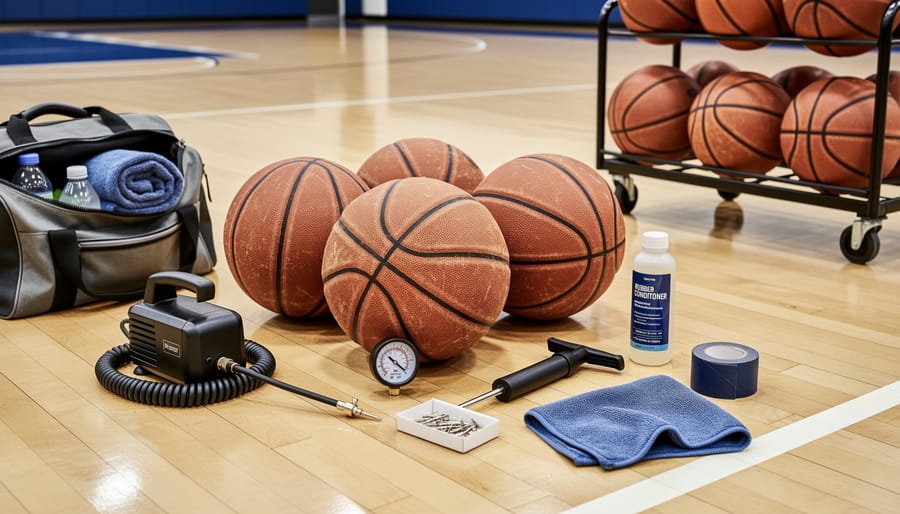
Proper storage and organization equipment maintains facility order and equipment longevity. Ball carts, constructed from welded steel or aluminum tubing, typically hold 12-30 basketballs with capacity clearly marked; models with lockable lids prevent unauthorized access. Equipment racks provide designated storage for training accessories, personal gear, and protective equipment, with wall-mounted systems saving floor space in compact facilities.
Ball pumps and pressure gauges ensure proper inflation (7.5-8.5 PSI for regulation balls). Dual-action pumps reduce inflation time, while digital gauges deliver more accurate readings than analog models. First aid stations should be mounted at regulation height (48-54 inches), stocked with sport-specific supplies including cold packs, adhesive bandages, and antiseptic wipes.
Water stations require sufficient capacity for teams and spectators; bottle-filling stations increasingly replace traditional fountains in Canadian facilities, reducing contamination risk. Position hydration points near benches and locker room entrances for convenient access during timeouts and breaks.
Selecting the right basketball equipment requires balancing performance needs, safety requirements, and budget constraints. Recreational facilities serving community programs can often meet their needs with mid-tier equipment, composite basketballs rather than leather, acrylic backboards instead of tempered glass, and durable synthetic court surfaces that handle varied use patterns. Competitive and professional venues demand higher-grade gear: FIBA-certified leather basketballs, tempered glass backboards with breakaway rims, and hardwood maple flooring that provides consistent bounce and player safety.
Safety certifications should guide procurement decisions for facility operators. Look for ASTM (American Society for Testing and Materials) ratings on basketball goals, CSA approval on electrical scoreboards, and compliance documentation for seating systems. Canadian climates present specific durability challenges: outdoor hoops need powder-coated steel frames and all-weather nets to withstand temperature swings and moisture, while indoor facilities must account for humidity control to protect hardwood floors and electronic equipment.
Warranty terms reveal manufacturer confidence and long-term value. Professional-grade basketball systems typically carry 5-10 year warranties on structural components, while budget options may offer only 1-2 years. For facility operators managing multiple courts, extended warranties and local service availability justify higher upfront costs. Individual purchasers face different calculations, a home driveway hoop might prioritize affordability and portability over 20-year durability.
Buying used equipment can stretch budgets for community centres, though structural items like basketball systems require thorough safety inspections. Stay informed about equipment store trends in procurement options and bulk purchasing programs that reduce costs without compromising quality. Quality equipment delivers better performance, requires less maintenance, and ultimately provides superior value despite higher initial investment.
The choices you make about basketball equipment depend heavily on who will use it, where it will be installed, and how often it will see play. These frequently asked questions address the practical concerns that come up most often when selecting and maintaining basketball gear.
Size 5 (27.5 inches) is standard for youth players ages 8-12, Size 6 (28.5 inches) for women and youth ages 12-14, and Size 7 (29.5 inches) for men ages 15 and up. These sizing standards ensure players develop proper shooting and handling mechanics with a ball scaled to their hand size and strength.
Indoor balls use leather or composite leather covers designed for hardwood courts, offering superior grip and control but wearing quickly on rough surfaces. Outdoor balls feature durable rubber covers that withstand concrete and asphalt but provide less feel and grip on indoor courts.
The standard rim height is 10 feet from the playing surface for all competitive levels from high school through professional play. Youth programs sometimes use 8- or 9-foot heights for younger age groups, though this varies by organization and developmental philosophy.
Permanent wall-mounted or ceiling-suspended systems offer superior stability and durability for dedicated basketball facilities, while portable bases provide flexibility for multi-use spaces but require more maintenance and storage considerations. The choice depends on whether the space serves multiple sports or functions primarily as a basketball venue.
Equipment lifespan varies significantly based on usage intensity and storage conditions. A quality indoor basketball used in a competitive setting might last two to three seasons with proper care, while the same ball in a recreational program could serve five years or more. Outdoor balls typically show wear faster, with covers degrading from sun exposure and rough surfaces after 12 to 18 months of regular use in Canadian weather conditions.
For new facilities, priority equipment includes regulation hoops and backboards, appropriate flooring, sufficient basketballs for practice and game scenarios, a reliable scoreboard with shot clock capability, and adequate storage solutions. Beyond these essentials, ball pumps, pressure gauges, first aid supplies, and player seating round out a functional basketball space. Facility operators should budget for higher-grade components in high-traffic areas while potentially scaling back on items like training accessories that can be added as programs grow.